

Which Are The 6 Criteria Air Pollutants Specified Under The Clean Air Act?
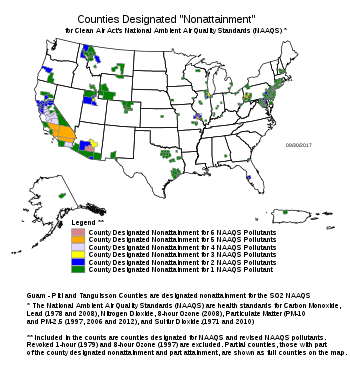
United states counties that are designated "nonattainment" for the Clean Air Act's NAAQS, equally of September thirty, 2022.
The U.Southward. National Ambient Air Quality Standards (NAAQS, pronounced naks) are limits on atmospheric concentration of six pollutants that cause smog, acid rain, and other wellness hazards.[ane] Established by the United states of america Environmental Protection Agency (EPA) under dominance of the Clean Air Deed (42 U.S.C. 7401 et seq.), NAAQS is practical for outdoor air throughout the country.[two]
The six criteria air pollutants (CAP), or criteria pollutants, for which limits are fix in the NAAQS are ozone (Oiii), atmospheric particulate thing, lead, carbon monoxide (CO), sulfur oxides (SO10), and nitrogen oxides (NO10).[three] These are typically emitted from many sources in industry, mining, transportation, electricity generation and agriculture. In many cases they are the products of the combustion of fossil fuels or industrial processes.[4]
The National Emissions Standards for Hazardous Air Pollutants cover many other chemicals, and require the maximum achievable reduction that the EPA determines is viable.
Groundwork [edit]
The six criteria air pollutants were the first fix of pollutants recognized past the United States Environmental Protection Bureau as needing standards on a national level.[5] The Clean Air Deed requires the EPA to set US National Ambient Air Quality Standards (NAAQS) for the 6 CAPs.[6] The NAAQS are health based and the EPA sets two types of standards: primary and secondary. The master standards are designed to protect the health of 'sensitive' populations such as asthmatics, children, and the elderly. The secondary standards are concerned with protecting the surroundings. They are designed to address visibility, damage to crops, vegetation, buildings, and animals.[seven]
The EPA established the NAAQS co-ordinate to Sections 108 and 109 of the U.South. Clean Air Deed, which was last amended in 1990.[8] These sections require the EPA "(1) to list widespread air pollutants that reasonably may be expected to endanger public wellness or welfare; (2) to issue air quality criteria for them that assess the latest available scientific information on nature and furnishings of ambient exposure to them; (3) to fix primary NAAQS to protect man health with adequate margin of safety and to fix secondary NAAQS to protect against welfare furnishings (due east.g., furnishings on vegetation, ecosystems, visibility, climate, manmade materials, etc); and (five) to periodically review and revise, as appropriate, the criteria and NAAQS for a given listed pollutant or form of pollutants."[9]
Descriptions [edit]
- Basis level ozone (O3): Ozone found on the surface-level, also known as tropospheric ozone is besides regulated by the NAAQS under the Clean Air Act. Ozone was originally found to exist dissentious to grapes in the 1950s. The U.s. EPA set "oxidants" standards in 1971, which included ozone. These standards were created to reduce agricultural impacts and other related amercement. Similar atomic number 82, ozone requires a reexamination of new findings of health and vegetation effects periodically. This attribute necessitated the creation of a The states EPA criteria document. Further assay washed in 1979 and 1997 made information technology necessary to significantly change the pollution standards
- Atmospheric particulate matter
- PM10, coarse particles: two.five micrometers (μm) to 10 μm in size (although electric current implementation includes all particles 10 μm or less in the standard)
- PM2.5, fine particles: 2.5 μm in size or less. Particulate Thing (PM) was listed in the 1996 Criteria document issued by the EPA. In April 2001, the EPA created a Second External Review Draft of the Air Quality Criteria for PM, which addressed updated studies done on particulate matter and the modified pollutant standards done since the First External Review Draft. In May 2002, a Tertiary External Review Draft was made, and the EPA revised PM requirements again. Afterward issuing a fourth version of the document, the EPA issued the concluding version in October 2004.
- Lead (Pb): In the mid-1970s, lead was listed equally a criteria air pollutant that required NAAQS regulation. In 1977, the EPA published a certificate which detailed the Air Quality Criteria for atomic number 82. This certificate was based on the scientific assessments of pb at the time. Based on this report (1977 Lead AQCD), the EPA established a "1.five µg/m3 (maximum quarterly agenda average) Atomic number 82 NAAQS in 1978.[10]" The Clean Air Act requires periodic review of NAAQS, and new scientific data published after 1977 made information technology necessary to revise the standards previously established in the 1977 Lead AQCD certificate. An Addendum to the certificate was published in 1986 and and then again equally a Supplement to the 1986 AQCD/Annex in 1990. In 1990, a Lead Staff Paper was prepared by the EPA'southward Part of Air Quality Planning and Standards (OPQPS), which was based on information presented in the 1986 Lead/AQCD/Addendum and 1990 Supplement, in addition to other OAQPS sponsored lead exposure/take a chance analyses. In this paper, it was proposed that the Pb NAAQS be revised farther and presented options for revision to the EPA. The EPA elected to not modify the Pb NAAQS further, but decided to instead focus on the 1991 U.Southward. EPA Strategy for Reducing Lead Exposure. The EPA concentrated on regulatory and remedial make clean-up efforts to minimize Pb exposure from numerous non-air sources that caused more severe public health risks, and undertook actions to reduce air emissions.
- Carbon monoxide (CO): The EPA set the get-go NAAQS for carbon monoxide in 1971. The master standard was set at nine ppm averaged over an 8-hour catamenia and 35 ppm over a i-60 minutes flow.[11] The majority of CO emitted into the ambient air is from mobile sources. The EPA has reviewed and assessed the current scientific literature with respect to CO in 1979, 1984, 1991, and 1994.[12] After the review in 1984 the EPA decided to remove the secondary standard for CO due to lack of significant evidence of the adverse environmental impacts. On Jan 28, 2022 the EPA decided that the electric current NAAQS for CO were sufficient and proposed to proceed the existing standards as they stood. The EPA is strengthening monitoring requirements for CO by calling for CO monitors to exist placed in strategic locations nigh big urban areas. Specifically, the EPA has chosen for monitors to exist placed and operational in CBSA's (core based statistical areas) with populations over 2.5 million by January one, 2022; and in CBSA's with populations of 1 1000000 or more than past January i, 2022. In addition they are requiring the collocation of CO monitors with NO2 monitors in urban areas having a population of one meg for more. As of May 2022 at that place were approximately 328 operational CO monitors in identify nationwide. The EPA has provided some authority to the EPA Regional Administrators to oversee case-by-case requested exceptions and in determining the need for additional monitoring systems to a higher place the minimum required.[13] The EPA reports the national boilerplate concentration of CO has decreased past 82% since 1980.[fourteen] The last nonattainment designation was deemed in attainment on September 27, 2022. Currently all areas in the US are in attainment.[13]
- Sulfur oxides (Soten): Thenx refers to the oxides of sulfur, a highly reactive group of gases. And then2 is of greatest interest and is used as the indicator for the entire Thenx family. The EPA first set primary and secondary standards in 1971. Dual chief standards were set at 140 ppb averaged over a 24-hour menses, and at 30 ppb averaged annually. The secondary standard was gear up at 500 ppb averaged over a iii-hour period, not to be exceeded more than than one time a yr. The most recent review took place in 1996 during which the EPA considered implementing a new NAAQS for 5-minute peaks of Thenii affecting sensitive populations such as asthmatics. The Agency did non constitute this new NAAQS and kept the existing standards.[fifteen] In 2022 the EPA decided to replace the dual primary standards with a new 1-hr standard set at 75 ppb. On March 20, 2022 the EPA "took concluding action" to maintain the existing NAAQS as they stood.[16] Only iii monitoring sites have exceeded the current NAAQS for SO2, all of which are located in the Hawaii Volcanoes National Park. The violations occurred between 2007-2008 and the country of Hawaii suggested these should be exempt from regulatory actions due to an 'exceptional event' (volcanic activity). Since 1980 the national concentration of SO2 in the ambient air has decreased past 83%.[17] Annual boilerplate concentrations hover between 1-6 ppb. Currently all ACQR's are in attainment for SOtwo.[18]
- Nitrogen oxides (NOx): The EPA beginning set primary and secondary standards for the oxides of nitrogen in 1971. Among these are nitric oxide (NO), nitrous oxide (N2O), and nitrogen dioxide (NOtwo), all of which are covered in the NAAQS. NOtwo is the oxide measured and used as the indicator for the unabridged NOx family as it is of the most concern due to its quick germination and contribution to the formation of harmful ground level ozone.[19] In 1971 the primary and secondary NAAQS for NOii were both gear up at an almanac boilerplate of 0.053 ppm. The EPA reviewed this NAAQS in 1985 and 1996, and in both cases concluded that the existing standard was sufficient. The well-nigh recent review by the EPA occurred in 2022, resulting in a new 1-hour NO2 chief standard prepare at 100 ppb; the annual average of 0.053 ppm remained the aforementioned. Likewise considered was a new ane-hour secondary standard of 100 ppb. This was the first time the EPA reviewed the environmental impacts separate from the health impacts for this group of criteria air pollutants[19] Also, in 2022, the EPA decided to ensure compliance past strengthening monitoring requirements, calling for increased numbers of monitoring systems near large urban areas and major roadways. On March 20, 2022 the EPA "took concluding action" to maintain the existing NAAQS every bit they stand.[xx] The national average of NOx concentrations has dropped by 52% since 1980.[21] The annual concentration for NOii is reported to exist averaging around 10-20 ppb, and is expected to decrease further with new mobile source regulations.[22] Currently all areas of the The states are classified as in attainment.[xix]
Standards [edit]
The standards are listed in 40 CFR 50. Chief standards are designed to protect man wellness,[23] with an adequate margin of safety, including sensitive populations such as children, the elderly, and individuals suffering from respiratory diseases. Secondary standards are designed to protect public welfare, damage to property, transportation hazards, economic values, and personal condolement and well-being from any known or predictable adverse furnishings of a pollutant. A district meeting a given standard is known equally an "attainment expanse" for that standard, and otherwise a "not-attainment area".[ii]
Standards are required to "accurately reflect the latest scientific knowledge," and are reviewed every 5 years past a Clean Air Scientific Informational Committee (CASAC), consisting of "7 members appointed past the EPA administrator."[24]
EPA has set NAAQS for half-dozen major pollutants listed as below. These half dozen are also the criteria air pollutants.[1]
| Pollutant | Blazon | Standard | Averaging Time | Coursea | Regulatory Commendation |
|---|---|---|---|---|---|
| Sulfur dioxide (And soii) | Primary | 75 ppb | 1-hr | 99th Percentile of 1-hour daily maximum concentrations, averaged over iii years | 40 CFR 50.17 |
| Secondary | 0.five ppm (1,300 μg/m3) | 3-hour | Not to exist exceeded more than than in one case per twelvemonth | 40 CFR 50.5 | |
| Particulate matter (PM10) | Primary and Secondary | 150 μg/m3 | 24-hour | Not to be exceeded more than than once per yr on average over 3 years | 40 CFR 50.vi |
| Fine particulate matter (PMii.v) | Master | 12 μg/m3 | annual | Almanac hateful, averaged over 3 years | xl CFR fifty.18 |
| Secondary | 15 μg/mthree | annual | Annual mean, averaged over 3 years | twoscore CFR l.7 | |
| Main and Secondary | 35 μg/m3 | 24-60 minutes | 98th percentile, averaged over iii years | twoscore CFR 50.eighteen | |
| Carbon monoxide (CO) | Primary | 35 ppm (40 mg/k3) | 1-60 minutes | Not to be exceeded more than in one case per year | 40 CFR 50.8 |
| Principal | 9 ppm (10 mg/k3) | eight-hour | Not to be exceeded more than once per year | 40 CFR 50.8 | |
| Ozone (Othree) | Chief and Secondary | 0.12 ppm (235 μg/m3) | ane-hrb | expected number of days per agenda year, with maximum hourly average concentration greater than 0.12 ppm, is equal to or less than 1 | 40 CFR l.9 |
| Principal and Secondary | 0.070 ppm (140 μg/m3) | eight-hr | Almanac fourth-highest daily maximum 8-60 minutes concentration, averaged over 3 years | forty CFR 50.19 | |
| Nitrogen dioxide (NOii) | Primary and Secondary | 0.053 ppm (100 μg/m3) | annual | Almanac mean | 40 CFR 50.11 |
| Primary | 0.100 ppm (188 μg/yardthree) | one-60 minutes | 98th percentile of 1-hour daily maximum, averaged over 3 years | forty CFR fifty.11 | |
| Pb (Pb) | Main and Secondary | 0.fifteen μg/kthree | Rolling 3 months | Not to be exceeded | twoscore CFR 50.12 |
- ^a Each standard has its own criteria for how many times information technology may exist exceeded
- ^b Every bit of June 15, 2005, the 1-hour ozone standard no longer applies to areas designated with respect to the 8-hour ozone standard (which includes near of the United States, except for portions of x states).
- Source: USEPA
Detection methods [edit]
The EPA National Exposure Research Laboratory can designate a measurement device using an established technological basis as a Federal Reference Method (FRM) to certify that the device has undergone a testing and analysis protocol, and can be used to monitor NAAQS compliance. Devices based on new technologies can be designated as a Federal Equivalent Method (FEM).[ citation needed ] FEMs are based on unlike sampling and/or analyzing technologies than FRMs, but are required to provide the aforementioned determination making quality when making NAAQS attainment determinations. Approved new methods are formally announced through publication in the Federal Register.[25] A consummate list of FRMs and FEMs is available.[26]
Air quality control region [edit]
An air quality command region is an area, designated by the federal authorities, where communities share a common air pollution trouble.[27]
See also [edit]
- Air pollution
- Air quality index
- Asthma
- Atmospheric dispersion modeling
- Contamination control
- Clean Air Human activity (1990)
- Portable Emissions Measurement Organisation
- Toxic Substances Control Act of 1976
References [edit]
- ^ a b "Definition of National Ambient Air Quality Standards (NAAQS)". ohioepa.custhelp.com . Retrieved 2018-03-29 .
- ^ a b "Trans-Alaska Pipeline System Renewal Environmental Affect Statement commodity". Archived from the original on 2022-x-20. Retrieved 2009-10-12 .
- ^ EPA,OAR, US (9 April 2022). "Criteria Air Pollutants | United states EPA". Usa EPA . Retrieved 2018-01-18 .
- ^ http://des.nh.gov/organization/commissioner/pip/factsheets/ard/documents/ard-41.pdf[ bare URL PDF ]
- ^ Michigan Department Of Environmental Quality, January 2004. What is an Air Contaminant Pollutant? Fact Sheet
- ^ "Archived re-create". Archived from the original on 2022-02-02. Retrieved 2011-02-eleven .
{{cite web}}: CS1 maint: archived re-create as title (link) US EPA - ^ "Archived copy". Archived from the original on 2022-12-ten. Retrieved 2010-12-08 .
{{cite web}}: CS1 maint: archived copy as title (link) - ^ "EPA - TTN NAAQS". Archived from the original on 2009-04-28.
- ^ "Air Quality Criteria for Lead (Terminal Report, 2006)".
- ^ "Air Quality Criteria for Lead (Concluding Report, 2006)".
- ^ "Air Quality Planning and Standards".
- ^ http://www.epa.gov/ncea/pdfs/coaqcd.pdf.[ bare URL PDF ]
- ^ a b "Air Quality Planning and Standards".
- ^ http://world wide web.epa.gov/airtrends/carbon.html.
- ^ "Sulfur Dioxide | Air & Radiation | US EPA".
- ^ http://www3.epa.gov/airquality/sulfurdioxide/pdfs/20120320factsheet.pdf.[ bare URL PDF ]
- ^ http://www.epa.gov/airtrends/sulfur.html.
- ^ "Air Quality Planning and Standards".
- ^ a b c "Air Quality Planning and Standards".
- ^ Fact Sheet – Air Quality Designations for the 2022 Primary Nitrogen Dioxide (NOii) National Ambient Air Quality Standards http://www.epa.gov/airquality/nitrogenoxides/designations/pdfs/20120120FS.pdf.
- ^ http://www.epa.gov/airtrends/nitrogen.html.
- ^ "Air Quality Planning and Standards".
- ^ "Early Implementation of the Clean Air Act of 1970 in California." EPA Alumni Association. Video, Transcript (see p4). July 12, 2022.
- ^ Goldstein, Bernard D (2018-12-11). "The latest chapter in EPA vs environmental science saga". The Hill . Retrieved 2018-12-13 .
- ^ "EPA scientists develop Federal Reference & Equivalent Methods for measuring cardinal air pollutants". U.S. Environmental Protection Agency. 2022-12-29. Retrieved 2017-06-28 .
- ^ Gilliam, Joseph H.; Hall, Eric Southward. (2016-07-13). "Reference and Equivalent Methods Used to Measure out National Ambient Air Quality Standards (NAAQS) Criteria Air Pollutants - Volume I". U.S. Ecology Protection Agency . Retrieved 2017-06-28 .
- ^ "EPA document".
External links [edit]
- EPA summary of the National Ambient Air Quality Standards
- US Ecology Protection Agency - Criteria Air Pollutants
- EPA summary for Air & Radiations
- EPA Light-green Book showing non-attainment, maintenance, and attainment areas
- Nigh Polluted Cities, 2005 – American Lung Association
- EPA Alumni Clan Oral History Video "Early Implementation of the Make clean Air Human activity of 1970 in California."

Source: https://en.wikipedia.org/wiki/National_Ambient_Air_Quality_Standards
Posted by: mcgheeallegs.blogspot.com
0 Response to "Which Are The 6 Criteria Air Pollutants Specified Under The Clean Air Act?"
Post a Comment